
The Difference Between Specialized and General Therapy for Sex Addiction
One of the greatest misunderstandings about sexual addiction, compulsive pornography, or sexual infidelity is the belief that the problem is simply lust, lack of discipline, or weak morality. While personal responsibility certainly matters, most individuals trapped in sexual addiction eventually discover something painful: sheer willpower alone is rarely enough to break the cycle.
Many men and women deeply love God. They pray or meditate. They confess. They promise themselves they will never return to the behavior again. Yet days, weeks, or months later, they often find themselves back in the same patterns they swore they hated.
This confusion creates profound shame.
Over time, many lies begin arising in their subconscious, the path to believing lies about themselves:
“I’m disgusting.”
“I’m spiritually weak.”
“God must be tired of me.”
“I’ll never truly change.”
But sexual addiction or betrayal is rarely sustained by lust alone. More often, it is fueled by shame, emotional isolation, wounds, fear, loneliness, and the desperate attempt to escape pain.
This is one reason specialized CSAT treatment matters.
I often think about a man I’ll call “Michael.” Michael was a husband, father, successful professional, and active member of his church. From the outside, his life looked solid. But privately, he had battled pornography since middle school. What started as curiosity slowly became a coping mechanism whenever he felt stressed, rejected, anxious, or emotionally overwhelmed.
For years, Michael believed his problem was simply that he “wasn’t trying hard enough spiritually.” He increased prayer, made promises to God, and repeatedly swore he would stop. After every relapse, he felt overwhelming guilt and self-hatred. He would go to confession feeling sincere and hopeful, but eventually the cycle returned again.
The deeper issue was that Michael did not understand what pornography had become for him emotionally. It was no longer merely a sinful behavior he occasionally chose. It had become a conditioned refuge — a false comfort whenever he felt inadequate, lonely, powerless, or emotionally disconnected.
Before finding specialized treatment, Michael had seen a general therapist who primarily focused on stress management and reducing shame. While some of that work was helpful, the deeper addictive system was never fully addressed. The therapist did not fully understand the compulsive cycle, the attachment wounds underneath it, or the way secrecy and shame continually reinforced the addiction.
What often gets missed in general therapy is that sexual addiction and betrayal trauma are rarely just behavioral problems. At the core of the shame cycle is usually a much deeper story — one often rooted in family-of-origin dysfunction, emotional neglect, attachment wounds, trauma, or chronic experiences of insecurity and disconnection. In the CSAT model, we understand that many addictive behaviors develop as maladaptive attempts to regulate pain, avoid vulnerability, or soothe unresolved emotional wounds. In other words, the compulsive behavior is often not the primary problem itself, but an attempted solution to deeper pain. Healing, therefore, requires far more than behavior management; it requires addressing the underlying trauma and distorted beliefs about self, relationships, and God that keep the shame cycle alive.
By the time Michael entered treatment with a CSAT-trained therapist, his marriage was hanging by a thread.
What changed was not merely that someone talked more openly about pornography. The entire framework changed. Instead of only asking, “How do we stop the behavior?” therapy began asking deeper questions:
“What pain is this behavior helping you escape?”
“What do you believe about yourself?”
“When did you first learn to hide?”
“What emotions feel intolerable to you?”
“How has shame shaped your relationship with God, yourself, and others?”
For the first time, Michael began realizing that shame itself had become fuel for the addiction cycle.
Many individuals struggling with sexual addiction already hate what they are doing. Shame is rarely absent. In fact, shame is often the gasoline keeping the entire system alive. The person feels emotionally overwhelmed, anxious, rejected, angry, lonely, or inadequate. They seek escape through fantasy or compulsive sexual behavior, experience temporary relief, then crash into guilt and self-contempt afterward. That shame then creates more emotional isolation, secrecy, and despair — eventually leading them back into the behavior again. Without understanding this cycle, therapy can unintentionally become superficial.
The Addictive System Illustration
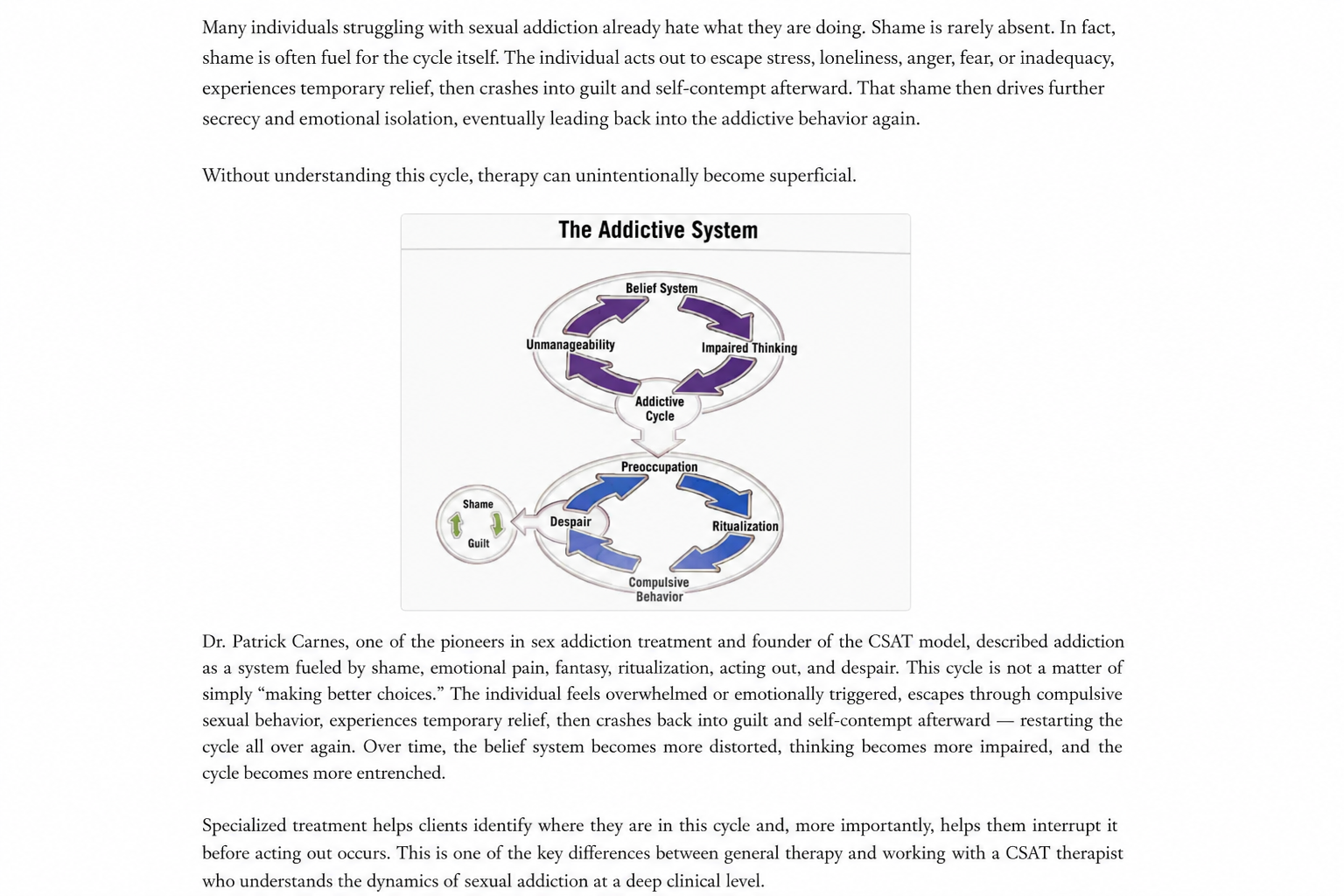
Dr. Carnes described addiction as a system fueled by shame, distorted beliefs, impaired thinking, ritualization, compulsive behavior, and despair. The cycle feeds itself. Over time, the individual’s belief system becomes increasingly distorted:
“I am unlovable.”
“I am too broken.”
“I will never change.”
“If people really knew me, they would reject me.”
From a Christian perspective, this is where addiction becomes deeply spiritual as well as psychological. Shame pushes people into hiding — just as Adam and Eve hid in the Garden after the Fall. Genesis 3 tells us that after sin entered the world, Adam and Eve became afraid, covered themselves, and hid from God. Since then, shame has continually whispered the same lie to humanity: “Hide who you are.”
Pornography addiction thrives in secrecy because shame convinces the individual that exposure equals rejection. But the Gospel tells a radically different story. Christ does not heal people by shaming them further. He heals by bringing truth into the light with both conviction and mercy. Throughout the Gospels, Jesus consistently moves toward the wounded, the hidden, and the ashamed. He exposes sin honestly while also restoring dignity to the person underneath it.
This is one reason why faith-integrated recovery can be so powerful when done properly.
Recovery is not simply about “trying harder” or becoming more religious externally. It involves learning how to live honestly before God and others. It means replacing secrecy with confession, isolation with brotherhood, compulsive escape with emotional maturity, and shame with grace rooted in truth.
A CSAT-trained therapist understands that pornography addiction is not only about stopping behavior. It is about healing the underlying wounds, attachment patterns, distorted beliefs, and emotional systems that keep the cycle alive. Specialized treatment helps individuals identify where they are in the addictive cycle and interrupt it before acting out occurs.
This work often includes:
developing emotional awareness
identifying triggers and vulnerabilities
building accountability and community
addressing trauma and attachment wounds
rebuilding integrity
restoring trust slowly over time
reconnecting spiritually in healthy ways
For many Christians, one of the hardest parts of recovery is separating conviction from toxic shame. Conviction says, “What you are doing is harming you and others.” Shame says, “You are worthless.” Conviction draws people toward repentance and healing. Shame drives people deeper into hiding.That distinction matters enormously.
Many people trapped in sexual addiction are not simply rebellious. They are exhausted. Isolated. Afraid. Ashamed. Some have spent years begging God to change them while secretly believing they are beyond healing. But healing is possible.
Recovery is ultimately not about perfect people proving themselves worthy. It is about wounded people learning to step into the light. Freedom often begins not when someone finally becomes flawless, but when they stop hiding. Specialized treatment matters because sexual addiction is complex. But beyond that, people need spaces where both truth and grace can coexist — where sin is taken seriously, but where shame does not get the final word.
Sources
International Institute for Trauma and Addiction Professionals (IITAP)
Dr. Patrick Carnes Biography and Contributions to Sex Addiction Treatment
Carnes, Patrick. Out of the Shadows: Understanding Sexual Addiction. Hazelden Publishing, 2001.
Carnes, Patrick. Facing the Shadow. Gentle Path Press, 2015.
Carnes, Patrick, Stefanie Carnes, and John W. Oakes. A Clinical Guide to the Assessment and Treatment of Sexual Addiction. Gentle Path Press, 2014.
Minwalla, Omar. “The Secret Sexual Basement: The Traumatic Effects of Deceptive Sexuality on the Intimate Partner.”
Laaser, Mark. Healing the Wounds of Sexual Addiction. Zondervan, 2004.
Weiss, Robert. Sex Addiction 101: A Basic Guide to Healing from Sex, Porn, and Love Addiction. Health Communications Inc., 2015.
Sacred Scripture: Genesis 3; John 8:1–11; Matthew 26:41
